Thursday, October 04, 2007

Leviathan of the Sky

© Michael Davis

The A380 landing on CVG Runway 18L. There are
20 wheels on the 4 main landing gear trucks!

CVG is a pretty busy airport. Around 65% of the air traffic is comprised of regional jets including Bombardier CRJ-200/700/900 and Embraer ERJ135/145 and 170 series. None of them carry over 90 passengers.

Yesterday was a pretty big day for CVG. The Airbus A380 stopped by for a promotional visit for all of the employees of the GE engine plant in Cincinnati. The A380's GP7000 engines are manufactured by Engine Alliance, joint venture of Pratt & Whitney & GE Aircraft Engines, headquartered in Cincinnati. The other engine choice for the A380 is manufactured by Rolls Royce/Trent.

After doing a low altitude fly over of the GE plant, the behemoth headed south for CVG in Northern Kentucky. It landed on runway 18L and taxied to the Airborne cargo ramp on the south end of the airport. It spent the day there giving GE employees the opportunity to see it up close and personal.

It was a big deal to see the A-380 here. CVG will never see service from an aircraft that size. Delta 767's are the biggest planes you'll see here.

It's going to be interesting taxiing behind one of these monsters. I bet full t/o thrust could turn a CRJ upside down.

Here are some more photos:

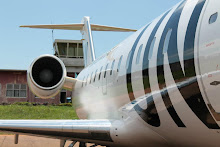
You could drive that Ford F-150 underneath the outboard engine.

When I look at the main wheels, I can't fathom the heat those brakes must generate.

The size of the wings is what impresses me most. They are HUGE.

Photos 1, 3 & 4 courtesy Michael Davis, Nashville Aviation Photographers. See all of his A380 photos here
Photo 2 courtesy of flycvg.

Tuesday, October 02, 2007

So Let It Be Written, So Let It Be Done

Monday was the Limitations and Memory Items Exam. It was the final written exam, the one that everyone dreads due to a 100% score requirement. Apparently, people do better under the pressure of having their job at risk. Everyone passed.

We have one more CRM class this week, then airport indoc and systems integration intro. Next week is systems integration where we take everything we've learned from company ops specs to aircraft systems and put them all together for the FINAL phase of training: Sims.

Sims start 10/15 and run through 11/1. The check ride is scheduled for 11/2. Hopefully the next 4 weeks will fly by. I'm ready to be done with initial training.

I've finally reached the training saturation point and am officially sick of all things CRJ related. Being away from home is something I'll have to get used to until I can locate to a base that is suitable for family. However, there will still be breaks in between where I can see them. 10 weeks is a very long time and I just miss my wife and kids. Nobody forced me to be here and there aren't any regrets. It's just hard.

Tomorrow is my wife's birthday. Our anniversary was last month and my daughter and youngest son have October birthdays that I'll be missing. We've all discussed special occasions and how they can be celebrated when everyone is together. A day is just a day. A special occasion is any time we can be together as a family. I thank God every day for my wife and children.

My attitude isn't as bad as it sounds right now. It's just one of those bumps. Maintain positive mental attitude.

Saturday, September 29, 2007

Hangar Night

Last night was hangar night. Basically, the class goes out to the maintenance ramp where an aircraft has been set aside for our use. Over the course of three hours we: did a pre-flight walk around inspection, inspected the avionics bay and aft equipment bay.

After all of the exterior activities were complete, it was time to open up the main cabin door and climb aboard. My sim partner and I were the first aboard and that meant we were tasked with doing the flight compartment safety check and firing up the APU. I've done it over 50 times in the simulator, but doing it for the first time in the actual aircraft was a little unnerving. If you do it wrong in the sim, the instructor has you do it again. If you do it wrong in the aircraft, it just might destroy a one million dollar APU.

It's amazing how accurate simulators are. When the battery master is flipped in the plane, it sounded just the way I expected it to. I love seeing the displays light up like Times Square. After doing the safety check and the APU start flow, it was time to press the APU START switch light. I love the way an APU sounds when it's firing up and it was especially gratifying to hear it from the cockpit for the very first time. This may sound corny, but I will never forget it.

The rest of the evening was spent practicing opening the emergency exits, learning the locations of all of the emergency equipment, opening and closing the main cabin door and galley service door, the crew escape hatch in the cockpit plus a few other things. It was a fun night.


In the cockpit getting ready to start the APU

Just after APU start...getting ready to turn on the AC Packs.

Wednesday, September 26, 2007

Teamwork

Today was the systems test. It was 100 questions about every system in the CRJ-200. I scored 97, but should have scored 100. Some day I'll learn to RTFQ/RTFA. Am I happy with a 97? Absolutely. 80 was passing. However, blowing questions strictly due to attention deficit is a bummer.

The time spent here in training is like living on a different planet. The only people that I have anything in common with right now are the other 13 members of my class. Our class of 14 is pretty tight-knit and a wonderful group of people from all walks of life. Our ages range from 22-42, with 13 men and one woman. Backgrounds range from fresh Embry Riddle grads to former engineers and a flight attendant. Everyone in the class performed well with no one scoring less than 95. That is a testament to teamwork. My room mate and I have had as many as 10 people at the apartment on nights and weekends, each contributing their particular strengths. By the time we wrapped up studying last night, not one person felt uncomfortable with any CRJ system.

After each hurdle is cleared, there is only a moment to breathe a sigh of relief. Now that systems is over, it's time for CRM, flight planning and performance. The next big exam is Monday, covering aircraft limitations and memory items. Passing score: 100%. No pressure there. Now does it make sense why I'm bummed about a 97?

The most difficult thing about training is being 2,000 miles away from my wife and children. I miss them so much and the 3 hour time difference makes communication difficult. In addition, being so wrapped up in myself and training means that I have no other contact with the outside world. Finding things to talk about is like pulling teeth. My head has been crammed full of new information with more on the way. The only recent news stories I can recall are the death of Luciano Pavarotti and disappearance of aviator Steve Fossett. Now if you want to talk with me about hydraulics, game on.

All I can say is my wife is the most wonderful, understanding person for putting up with all of this. Aviation is definitely a selfish business.

I saw something funny not too long ago:

"The average pilot, despite the somewhat swaggering exterior, is very much capable of such feelings as love, affection, intimacy and caring...These feelings just don't involve anyone else."

I'm ashamed to admit that I'm starting to see myself that way right now. The check ride has been scheduled for November 2nd. God bless my family for the willingness to stick it out.

Sunday, September 23, 2007

Training Week 4: Family Orientation and Systems

First thing Monday was the final exam for indoc. Everyone in the class passed and the instructor said that she can't remember a time when everyone scored over 90. At noon, it was time for family orientation. The airline flew class members' families out for the day to meet management, enjoy a nice catered lunch and hear about life as an airline pilot. Afterwards, they were given a tour all of the company facilities and the simulators. It was a pretty nice thing to do. Monday was a good day.

Tuesday was the first day of systems class. It felt good to be re-immersed in to CRJ systems. As much as I thought had been forgotten started to come back out of long term memory storage. That is a very good thing as the CRJ is a complicated aircraft. I remember how difficult it was the first time around and am glad to have a leg up.

In the first four days we covered EICAS (Engine Information and Crew Alerting System), AC/DC electrical system, APU (Auxiliary Power Unit), Fuel System, Powerplant, Environmental Control System, Ice & Rain Protection, Fire Protection, Hydraulics, Landing Gear, Flight Controls, EFIS (Electronic Flight Instrument System), Oxygen & Emergency Equipment and Lighting. That's enough for four days, right?

Monday & Tuesday we'll be finishing up on systems with Navigation, Communications, EGPWS (Enhanced Ground Proximity Warning System 0r E Jip Whiz for short), Water & Waste, Aircraft Doors & AFCS (Automatic Flight Control System). Wednesday is the comprehensive systems test which is about 100 questions covering all systems. Multiple choice, true/false and my favorite...fill in the guess. Oh well, it's just another hurdle in a seemingly never ending race.

Thursday is the first of four CRM (Crew Resource Management) classes and Friday night is hangar night. We'll be spending about 8 hours in a CRJ learning about and performing tasks like pre-flight and emergency procedures.

Since I'm in severe study mode, if anyone has questions about the systems of the CRJ-200, I'll try to answer them for you. It will definitely be good study matter for me. Keep in mind, this is from a pilot's level of knowledge - not an A&P. I can't and won't build the system for you.

For anyone interested in learning a little more about the CRJ-200, here are some images of cockpit panels and descriptions of what each switch, switch light, button and dial does. Enjoy.


Above are the left and center overhead panels.

Above is the right overhead panel along with lighting, oxygen and mag compass
Above is the glare shield, minus the AFCS, and the captain's side panel. The triangular black handle is called the tiller. It is used to steer the aircraft on the ground, up to 70 degrees.

The above panels are from the lower pedestal. There are several detail panels missing including the throttle quadrant, main radio tuning units, audio panels and FMS.

Saturday, September 15, 2007

Training Update - Week 3

Another week has passed bringing my classmates and I a little closer to livin' the dream.

For the most part, indoc class is over. On Monday morning we have the final exam. The indoc exam will cover: company policies and procedures, flight and duty regs, takeoff minimums, departure and destination alternates including company specific ops specs, ops specs that allow Cat II precision approaches down to 1,200 RVR (runway visual range), flight planning and dispatch requirements, MEL (minimum equipment list) & CDL (configuration deviation list) and more.

It sounds like a lot, but shouldn't be too difficult. 80 or better is passing unlike the upcoming limitations and memory items test, which require 100% and there are NO retakes.

After the test is family orientation. It's a pretty nice thing. The company provides air transportation for spouses and other family members to come to Cincinnati for a tour of headquarters, the training center and the simulator facilities. My wife is coming out tomorrow morning and will be here for 2 days! I'm really excited about seeing her and wish the kids could come too. Being away from them for so long is really hard.

After orientation day, it will be time for the meat and potatoes of training: systems class
Systems covers everything from nose to tail on the CRJ200. It will be mostly a refresher, with a few company specific differences in operation and limitations. I'm looking forward to it.

Happy flying.

Saturday, September 08, 2007

The Best Museum EVER

My roommate Brad and I decided to take a short road trip today to the National Museum of the US Air Force at Wright Patterson AFB in Dayton, OH. This museum is a must see. And best of all, admission is free!

The museum's collection contains hundreds of aircraft that date from the dawn of aviation to the F-22. One of the most special areas is The Presidential Gallery. It contains several aircraft that served US Presidents from FDR to Bill Clinton. Of course, the jewel of the collection is SAM26000...

one of several Boeing VC-137 (707-320B) aircraft that served US Presidents. SAM26000 is most famous for being the aircraft that carried the body of John F. Kennedy from Dallas in November 1963 as Lyndon Johnson was sworn in as the next President. You can still see the marks where the bulkhead was cut to make room for Kennedy's casket in the aft main cabin. The crew refused to let his casket travel in the cargo bay. You can just feel the history in the air walking through through this famous aircraft.

This is a B-58 Hustler. Like all of the aircraft at the museum, it is pristine. I think the B-58 is one of the most wicked looking aircraft ever designed. The thing with orange paint on it is an escape pod. There were 3 on the Hustler, each capable of safely ejecting a crew member at 50,000+ feet at Mach 2. I love this plane.

This is Bockscar, the Boeing B-29 that dropped Fat Man on Nagasaki, Japan on August 9th, 1945. There are also replicas of both Fat Man & Little Boy next to Bockscar.

This is the North American XB-70 Valkyrie. It is massive. It was conceived in the 1950's as a supersonic high altitude bomber capable of Mach 3. It first flew in 1964 and achieved Mach 3 in 1965. Only two were ever built and the other one crashed after a mid-air collision.

The XB-70 is powered by 6 specifically built GE engines with afterburners and 30,000 lbs of thrust each.

The cost of the project was enormous and the Valkyrie project was retired in 1969 and has been at the museum ever since. Photos do not do this aircraft justice. The cockpit sits as high as one of a 747.

Look at the size of those jet pipes! Ever seen a plane with six in a row? Me either.

I took about 100 photos at the museum, but Blogger only allows 5 photos at a time, so check them out and enjoy.